
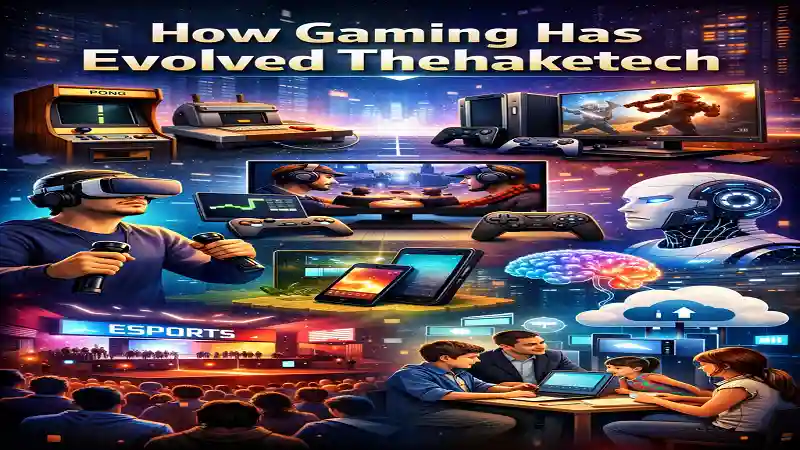
Gaming has grown from a simple form of entertainment into a powerful cultural and technological force. Over the decades, it has shaped how people interact with technology, learn new skills, and connect with one another. This article explores how gaming has evolved thehaketech by looking at its journey from early experiments to the advanced digital ecosystems of 2026. The focus here is purely informational, aiming to explain changes in gaming hardware, software, player behavior, and technological influence in a clear and easy-to-read way.
The Early Days of Gaming: Simple Beginnings
Gaming began with very basic ideas and limited technology. In the 1970s and early 1980s, games were simple, often built around one idea and a few rules. Early arcade titles like Pong showed that interactive digital play could attract attention and excitement.
During this period, gaming technology relied on simple processors and minimal graphics. Sound effects were basic, and gameplay focused on improving reflexes and hand-eye coordination. Even with these limitations, gaming laid the foundation for future innovation. These early systems proved that technology could be fun, engaging, and social.
The Rise of Home Consoles and Personal Computers
As technology improved, gaming moved into homes. Consoles and personal computers made games more accessible to families and individuals. Systems developed by companies such as Nintendo and Sega introduced colorful graphics, memorable characters, and longer gameplay experiences.
Personal computers also became an important platform. They allowed for more complex games, including simulations and strategy titles. This era showed how gaming has evolved thehaketech by pushing hardware manufacturers to create faster processors, better storage, and improved input devices like keyboards, mice, and controllers.
Advancements in Graphics and Sound Technology
One of the most visible changes in gaming has been the improvement in graphics and sound. Early pixel-based visuals slowly transformed into detailed 3D worlds. By the late 1990s and early 2000s, consoles such as those from Sony and Microsoft introduced systems capable of realistic lighting, textures, and physics.
Sound design also evolved. Games began using full musical scores and voice acting, making stories more emotional and immersive. These advancements influenced broader technology fields, including animation, audio engineering, and digital design. The connection between gaming and technology became stronger with each generation.
Online Gaming and the Birth of Digital Communities
The introduction of the internet changed gaming forever. Online multiplayer games allowed players from different parts of the world to interact in real time. This shift created digital communities centered around cooperation, competition, and shared experiences.
Online play demonstrated how gaming has evolved thehaketech by driving demand for faster internet speeds, secure servers, and advanced networking systems. Games were no longer isolated experiences; they became social spaces where friendships formed and teamwork mattered. Communication tools such as in-game chat and voice systems also influenced how people interact online beyond gaming.
Mobile Gaming and Accessibility
The rise of smartphones brought gaming to a much wider audience. Mobile games required less time and technical knowledge, making them accessible to people of all ages. Touchscreens, motion sensors, and portable devices introduced new ways to play.
Mobile gaming showed that powerful experiences did not always require expensive hardware. This stage of evolution highlighted efficiency and user-friendly design. It also demonstrated how gaming has evolved thehaketech by encouraging developers to optimize software for smaller devices while still delivering engaging gameplay.
Virtual Reality and Augmented Reality Experiences
Virtual reality (VR) and augmented reality (AR) added new dimensions to gaming. VR places players inside fully digital environments, while AR blends digital elements with the real world. These technologies require advanced sensors, displays, and processing power.
By 2026, VR and AR gaming have become more refined and comfortable to use. Improved headsets, better motion tracking, and reduced latency have made immersive experiences more common. These innovations influence not only gaming but also education, training, and design, showing again how gaming has evolved thehaketech through experimentation and technical growth.
Artificial Intelligence in Modern Games
Artificial intelligence (AI) plays a major role in modern gaming. Early games used simple patterns for enemy behavior. Today, AI systems can adapt to player actions, create realistic characters, and generate dynamic environments.
In 2026, AI-driven game design allows for personalized experiences. Games can adjust difficulty, story paths, and challenges based on how individuals play. This use of AI highlights how gaming has evolved thehaketech by contributing to broader advancements in machine learning and data analysis.
Cloud Gaming and Streaming Technology
Cloud gaming removes the need for powerful local hardware by processing games on remote servers. Players stream games directly to their devices, similar to watching a video online. This approach relies on strong internet infrastructure and efficient data compression.
By 2026, cloud gaming has become more stable and widely available. It supports cross-device play, allowing users to switch between screens easily. This development emphasizes accessibility and flexibility, reflecting ongoing changes in how technology is used and shared.
The Role of Gaming in Education and Skill Development
Gaming is no longer limited to entertainment. Educational games and simulations help people learn problem-solving, critical thinking, and teamwork. Strategy games encourage planning, while creative games promote imagination and design skills.
Serious games are also used in professional training, such as simulations for complex tasks. These applications demonstrate how gaming has evolved thehaketech by showing that interactive digital experiences can support learning and real-world skill development.
Gaming Culture and Social Impact
Gaming has created a global culture with its own language, traditions, and shared memories. Events, competitions, and online discussions bring people together across borders. This cultural influence shapes how technology is perceived and adopted.
In 2026, gaming culture continues to influence music, art, and storytelling. It also raises discussions about balance, well-being, and responsible technology use. Understanding this cultural impact is essential when examining the broader role of gaming in society.
Looking Ahead: Gaming Technology Beyond 2026
The future of gaming will likely focus on deeper immersion, smarter systems, and greater inclusivity. Advances in hardware, software, and connectivity will continue to blur the line between digital and physical experiences.
As technology progresses, gaming will remain a testing ground for new ideas. Its evolution shows how interactive entertainment can drive innovation across many fields. The ongoing story of gaming clearly explains how gaming has evolved thehaketech and why it remains a key part of modern technological development.
Conclusion
From simple arcade games to advanced digital worlds, gaming has undergone remarkable change. Each stage of development has pushed technology forward while shaping how people interact, learn, and connect. By 2026, gaming stands as a powerful example of innovation driven by creativity and user engagement. Understanding how gaming has evolved thehaketech helps explain not only the past of gaming but also the future direction of technology as a whole.Then stay in contact with our website